
Register for IP Showcase
on the Water @ IBC
Sunday September 13, 2026
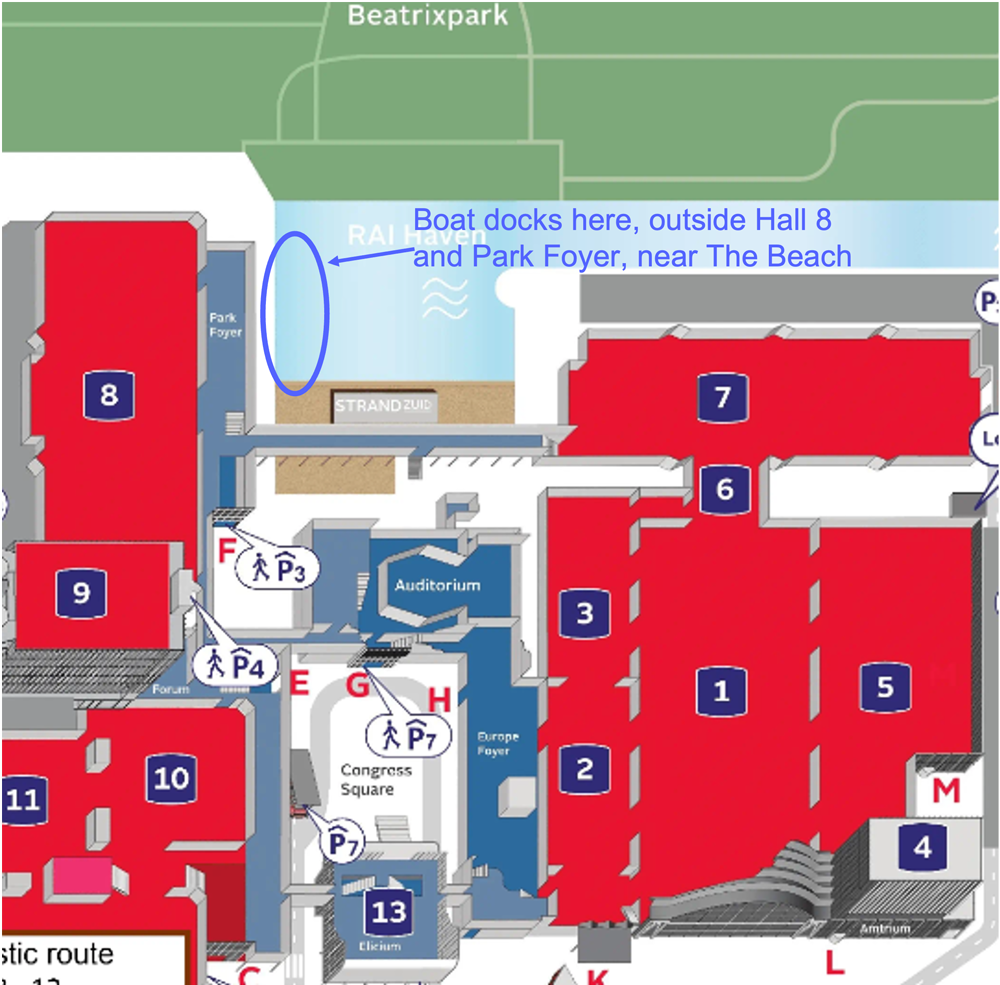
The boat leaves on the hour, 10:00 to 16:00, from the dock next to the RAI, Sunday September 13, 2026. Each voyage will focus on a specific topic and feature two presentations as shown in the schedule below.
Presentation Schedule
Vincent Trussart, Grass Valley
Now 22 months old, the EBU MXL project reaches version 1.1 with major new capabilities, including mxl-fabrics for accelerated inter-host media flow replication. The presentation explores MXL’s rapid industry adoption, latest innovations, and its role within the broader JT-DMF dynamic media facility initiative.
Hartmut Opfermann, BFE Studio
This session focuses on the end-to-end lifecycle of flows and domains in the Media Exchange Layer (MXL) of a Dynamic Media Facility (DMF). It examines interface specifications and the integration of different control-plane components and tools that are needed to create interoperable, multi-vendor, software-based media workloads.
Thomas Gunkel, Skyline Communications
This presentation explores how Dynamic Media Facility architectures enhance flexible, usage-based media production by orchestrating resources across vendors and workflows. Drawing on real-world collaborations, it highlights current capabilities and challenges in advance planning of compute, bandwidth, and licensing. It outlines practical approaches and templated planning to support efficient, scalable resource lifecycle management.
Nicolas Stumel, NSI2 Consulting
PTP is locked. NMOS is connected. BCP-008 redundancy is healthy. Dashboards are green, yet operators still face black video, silent audio, wrong sources, routing mistakes and hidden failures. This session explores the gap between standards compliance, observability and the operational reality of modern media networks through real-world failure case studies.
John Mailhot, Imagine Communications
Model Context Protocol (MCP) is an open standard method for exposing data and capabilities of existing equipment and tools, so that AI-based models and systems can efficiently interact with them. By using an open standard approach, equipment vendors can confidently build interfaces that will work across the new generations of AI models and capabilities that come out frequently. This talk focuses on what MCP is and what kinds of capabilities it enables.
Bastian Stolk, PlexusAV
Event Control Center needed to integrate diverse video sources across temporary venues with limited bandwidth. Using the PlexusAV Stream Conversion Gateway to unify formats on IPMX, combined with H.264/H.265 compression, they consolidated operations at scale. Result: 100% uptime across 20+ festivals and 24+ simultaneous deployments.
Chris Lennon, Ross Video
One of the most pervasive challenges our industry has faced has been the proliferation of proprietary non-secure control protocols. This has only gotten worse with the shift to the cloud and hybrid workflows. Not only do implementers have to support hundreds of these protocols, but with most of them lacking security, this is a huge potential exposure for media companies.
SMPTE has just posted the suite of ST 2138 standards to provide an open standard, open source solution to this problem. We will provide a high-level overview of what's covered in the suite, and other goodies that make trying it out surprisingly simple.
Another effort, the Dynamic Media Facility initiative has gained significant traction in our business. One of the key areas identified as important within DMF is an open means of control. In addition DMF's MXL component fits very nicely in with what has been done in ST 2138, and we will demonstrate how these new technologies complement each other.
Andy Rayner, Appear
There is a lot of work ongoing in the industry to define many elements of a hybrid Dynamic Media Facility.
One key component of this work is the focus on timing through the linear and asynchronous parts of a live production workflow.
This presentation will focus on bringing the audience up to speed on the intense and fruitful work that has been going on thus far and a succinct overview of the key principles that have been defined.
Jonathan Thorpe, NVIDIA
The JT-DMF Flow Connection Working Group defines requirements for managing MXL flows in Dynamic Media Facilities. This session shows how AMWA BCP-007-03 meets those requirements using NMOS IS-04 and IS-05, with nmos-cpp and nmos-js reference implementations and conformance test suites for MXL Nodes and Controllers in the NMOS Testing Tool.
Noor Hassan, Amazon Web Services
Software licensing is a frequently cited barrier to cloud and IP adoption in broadcast. The IAMT Dynamic Software Licensing initiative has published an open best-practices framework and working reference implementation on GitHub. This session demonstrates identity-based licensing, automated failover, and API-driven lifecycle management through live scenarios.
Andreas Hildebrand, Lawo
The EU Cyber Resilience Act enhances cybersecurity standards of products that contain a digital component, requiring manufacturers and retailers to ensure cybersecurity throughout the lifecycle of their products. The CRA entered into force on 10 December 2024 and it will be in full force from 11 December 2027. This presentation sets out the scope of the CRA, the key obligations for manufacturers, potential sanctions, but also touches on the responsibilities of system integrators and operators.
Sydney Lovely, Amazon Web Services
VSF TR-12 Client Device Discovery (CDD) defines an open, vendor-neutral method for ground-based devices to discover, authenticate, and connect to cloud services without requiring on-site networking experts. This talk presents the architecture and the the open source SDK enabling manufacturers to rapidly add cloud connectivity.
Rob Moody, Matrox Video
Manufacturers are increasingly talking about IPMX certified products – we never had this with ST2110 products – so this aspect is a new experience to many. It is a differentiating feature of IPMX – so long as buyers know what it stands for.
Gauthier Thieren, intoPix
This presentation presents a new approach to live production, bridging cameras to GPU processing using JPEG XS over RoCEv2/RDMA. It compares this approach with ST 2110 and shows how this model supports scalable camera arrays and next-generation automated workflows.
-
Session 1: MXL & Dynamic Media Facilities10:00 am - 11:00 am
-
Session 2: MXL & Dynamic Media Facilities11:00 am - 12:00 pm
-
Session 3: Managing Dynamic Media Facilities12:00 pm - 1:00 pm
-
Session 4: Troubleshooting & Cyber Resilience1:00 pm - 2:00 pm
-
Session 5: Control Planes for AI & Cloud2:00 pm - 3:00 pm
-
Session 6: IPMX: Enhancing ST 2110 for Cost Effective Media Deployments3:00 pm - 4:00 pm
-
Session 6: IPMX Case Studies & Certification3:00 pm - 4:00 pm
-
Session 7:4:00 pm - 5:00 pm
-
EBU DMF MXL Project update: SDK 1.1Vincent Trussart, Grass Valley10:00 am - 11:00 am
-
How to Control and Orchestrate a Multi-Vendor DMFHartmut Opfermann, BFE Studio11:00 am - 12:00 pm
-
Resource Planning & Orchestration in DMF – Where Are We? What’s Nnext?Thomas Gunkel, Skyline Communications12:00 pm - 1:00 pm
-
Everything Is Green, Yet Nothing WorksNicolas Stumel, NSI2 Consulting1:00 pm - 2:00 pm
-
Enabling the AI Revolution - Model Context Protocol (MCP) and Why It MattersJohn Mailhot, Imagine Communications2:00 pm - 3:00 pm
-
Case Study: Converging to IPMX: Unifying Multiple AV Standards in Large-Scale Event OperationsBastian Stolk, PlexusAV3:00 pm - 4:00 pm
-
SMPTE ST 2138: Open Source Control and its intersection with DMFChris Lennon, Ross Video4:00 pm - 5:00 pm
-
The DMF & Making Timing Work Along the Entire Live Production ChainAndy Rayner, Appear10:00 am - 11:00 am
-
JT-DMF Flow Connection for MXL: Standardizing Connection Management with NMOSJonathan Thorpe, NVIDIA11:00 am - 12:00 pm
-
Dynamic Software Licensing: An Open Framework and Reference Implementation for IP-Based Media WorkflowsNoor Hassan, Amazon Web Services12:00 pm - 1:00 pm
-
Security: Overview on EU Cyber Resilience Act - What Is It? How Does It Affect Manufacturers and Users in the Broadcast Space?Andreas Hildebrand, Lawo1:00 pm - 2:00 pm
-
Bridging the First-Mile Gap: VSF TR-12 Client Device Discovery for Cloud Media WorkflowsSydney Lovely, Amazon Web Services2:00 pm - 3:00 pm
-
IPMX Certified Products – the Implications of CertificationRob Moody, Matrox Video3:00 pm - 4:00 pm
-
From Cameras to GPU: Live Production Architectures with ST 2110 and RoCEv2/RDMA using JPEG XSGauthier Thieren, intoPix4:00 pm - 5:00 pm
Map to Canal Boat Dock
(Click to enlarge)